Thursday, June 28, 2007
Inspiration from Alec Baldwin

Sunday, June 24, 2007
How to avoid mushy Kraft Dinner!

Saturday, May 26, 2007
Trunkslammers!
All pics from the shoot can be seen here.
Sunday, April 08, 2007
Micromanagement - Breakfast Club Style

Sunday, April 01, 2007
Oh, the Places You'll Go!

Sunday, March 25, 2007
How Not to Write a Job Ad for Advertising Specialties Sales People

I continually scratch my head at the the type of people who write job ads like the one I just came across on Craig's List. I understand this employer wants a keen sales rep to bring in sales. Yes, sales people need to bring in business at the end of the day .... how they achieve this goal is the subject of another discussion.
Customers - run for cover!!! Mr. Alligator Grizzly Bear Ball Buster is out to sell you some pens, flashing baubles and white coffee mugs!! Reject him at your peril!!
------------------------------------------------------------
Ad Specialty Sales $1,000 + wk
Looking to train experienced salespeople to sell Ad-Specialties.
This position is about building your own business within a business.
Successful applicants will learn how to sell all types of Ad Specialty products.
Once you have achieved an income of at least $1,000 per week for six months you will start building your own crew of salespeople. Your income will be limited only by your work ethic and imagination.
-Qualified applicants will be hard working, self-disciplined and goal oriented.
-Be responsible and punctual.
-Want to make as much money as humanly possible.
-Have the hide of an alligator
-Be prepared to rip the hair off the balls of a grizzly bear
WARNING:
Slackers, Liars, Deadbeats and Wimps need not apply.
Saturday, March 17, 2007
The Growth Dilemma
I love farmer's markets as they are filled with such interesting vendors. Most of them are pretty quirky and have strong personalities. It is pretty evident when you are speaking with the owner at one of these places. They are the ones who know what you ordered last week, that your toddler likes poppy seed bagels, who enthusiastically recommend the basil-lemon mustard to go with the sausage you just bought, point out the best head of broccoli, and always cut the ham just the right way. They just get it.
Then you come the next week and the owner is busy serving another client. No problem, except for the fact that the owner's nephew is helping out this week. The nephew does not get it. He reaches for the limp broccoli, fumbles with the credit card machine (or even worse, informs you that you cannot charge $13.11 worth of goods on the card because it contravenes the "no visa under $20 policy"), he slices instead of shaves the ham, and he fails to connect with you about anything. The exchange is a transaction vs an experience.
I return the following week. Again, the owner is swamped with other clients. "Uh oh", the nephew is eyeing me, looking to help. I pretend to continue shopping, all the while hoping that the owner will look up and take my order. No luck, I keep delaying ... keep avoiding the nephew. Eventually, I succeed and I place my order with the owner, the only one who gets it.
This situation is not uncommon in business. A passionate owner, recognizing they can't do it all, hires others to help grow the business. Suddenly, a new person starts answering the phone. Their voice is different, their disposition is different, their product knowledge is different, and they are pretty good at enforcing company policies that you were previously unaware of ... all told, you feel something is missing.
Of course, this is the ultimate challenge. How does a business owner empower the people around them to act like themselves - stamping their DNA onto the people who work with them, so to speak. I know of many amazing businesses that have done this very well, though I know of many others that fail miserably. Unless you are dealing with "Bob the owner", you walk. This is unfair to Bob as he is just too busy ... why won't my clients just deal with the "nephew"?
The companies that nail this concept end up winning. In my experience, training the people around you to "get it" is the most important thing you can do in growing your business. Yes, it is essential that you hire people that have a range of experiences, but if you can't bottle up what is special about your business (and you) and give it to these new hires, you will end up with an uphill battle on your hands.
I speak from experience. Right Sleeve is a very demanding place to work. We are fanatical about delivering a "wow" customer experience and those that do not get this, end up leaving very quickly. Unfortunately, more people end up NOT working out than the ones that do. Why is this? While growth is very important to us, we are not prepared to sacrifice a quality customer experience for anything. All of our staff have to connect with our clients.
If people think and act like this is a product business, their chances for success are limited. This is a people business first and a product business second. Come on - we sell branded promotional products!!! However, what is special about this place is the effect that these products have on the people who order them (making them look good in front of their boss or clients). This is powerful stuff ... and a hard concept to teach.
I feel like we have made some tremendous sacrifices in our quest for the perfect team. While I know deep down inside that we could quadruple overnight if we hired a small army of salespeople, I am not prepared to become the kind of company staffed by too many "nephews" and too few "Bobs". Why? While in the short/medium term, it would be brilliant strategy for growth, I'd pay the price in the long term. (do you think Howard Schultz may have been thinking this when he wrote his "Starbucks is becoming soulless" companywide email in Feb 2007)?
Growth is still very important to us. But it just takes time to find the right people. It takes time to hire them, train them, develop them. Our management team has been around for years and we have highly dedicated, passionate people who take ownership over what they do. These are the kind of people who genuinely say they have fun at work. I know they represent this company as well - if not better - than me.
The ones who don't work out have difficulty understanding the path to success involves patience, training, learning from setbacks, dealing with criticism, listening, and truly caring about their work and the impact it has on others (vendors, colleagues and clients). This is hardly an overnight process.
When done right, everyone acts like "Bob the owner" and the passion permeates the business meaning the experience is never diluted for the customer.
Tuesday, March 13, 2007
The Machine is Us/ing Us
This is worth the 4 minutes ...
Saturday, March 10, 2007
Fabulous quotes
-----------
When people are least sure, they are often the most dogmatic (JK Galbraith)
Imagination is more important than knowledge (Albert Einstein)
Coffee is for closers (Alec Baldwin in Glengarry Glenross)
Where there is no vision, people perish (Proverbs 29:18)
Things do not change; we change (Henry David Thoreau)
Until you try, you don't know what you can do (Henry James)
Man cannot discover new oceans until he has courage to lose sight of the shore (Anon)
A crank is a man with a new idea - until it catches on (Mark Twain)
If you do what you've always done, you'll get what you've always gotten (Anon)
Friday, March 09, 2007
Leadership

The staff we attract enjoy selling our fun/hip/trend setting products to image conscious companies. Working with headstrong, creative, opinionated people can be a challenge. However, giving a group of people like this a voice to express themselves can have extraordinary results.
For example, in a recent session about how we were going to communicate our top sellers to clients, we honed in on the idea of a Staff Top Ten list. In order to give this promotion a little more personality, the team decided it would be fun to showcase ourselves as the style makers behind the products. Fast forward to the creative ... we now have people striking poses in the Number 10 to represent the Top Ten theme so we could capture the meaning of the promotion on our web site.
These exercises are often very random and the energy in the room is unbelievable as it allows members of the team to express themselves as well as feel connected to the overall mission of the company - to deliver a WOW experience to our clients. You can read more about the exercise here.
Ownership
In addition to these creative sessions, I ask each staff member to be a weekly "Learnings Chair" where they moderate a discussion based on a case study of their choosing in their assigned week. This case study may be a chapter from a book, blog post, magazine/newspaper article or podcast. This topic is distributed to all staff a few days in advance.
Monday, March 05, 2007
Herd mentality

Herd mentality is fascinating.
Have you ever noticed that whenever a plane lands, taxis to the gate, and turns off the seat belt sign that 95% of the passengers instantly jump up, rush to get their bags from the overhead bins ... and then proceed to wait for several minutes (still standing) before the plane's doors open?
Where are they going in such a rush? Is the guy in the seat behind me going to get off the plane faster than me when the doors open? It seems so unfair - he has been standing with bag in hand for 5 minutes while I sit there relaxing (and I still get off before him .... after all, I am still seated ahead of him). It only takes a few seconds to get your bag in the overhead bin. (and yes, I have traveled with my family as well as by myself).
To be clear, I am not a slow poke. I am usually in a hurry, but I just don't get why people rush just to stand there? Why not sit back, relax and wait until the doors open? Then grab your bag and be on your way. Standing in the aisle will not speed anything up, other than just congest the aisle and cause back pain.
Ever since I can remember, people have always rushed to stand after a flight arrives at the gate. It seems somehow ingrained in the traveler's DNA, but it does not seem to affect one's ability to get off the flight any faster. This is just what people do, as though they are following some sort of rule book.
Here's the point. Why do what everyone else does, especially when "what everyone else" does is kind of silly when you step back and really look at the situation?
It's pretty liberating to do things differently - in life, business, etc. Sometimes doing it the way everyone always does it only satisfies our need to be like others, but it is not necessarily the best way.
(author's note - while I may be onto something with this deplaning business, I still engage in many other silly and herd like activities, so I am not playing high and mighty. I still have plenty to learn!)
Tuesday, February 20, 2007
The Power of Core Values

In the past, I was never a believer in committing core values to paper. I always knew they were important, and while we certainly abided by a set of core values in our heads and hearts before, I chalked up the actual "writing of them down" as corporate schlock and rhetoric. Did anyone really care? If any of you have seen Office Space, you know what I mean (i.e., big, grey company asking its people "Is this Good for the Company"?)
I have since parked my skepticism as I found the process of committing tried and true values to paper to be liberating. Someone once told me that you know you have nailed a core value when writing it down gives you goose bumps. I mean, it actually has to mean something in order for it to be that powerful. That changed my perspective immediately. What was it that was so exciting about this place when it was just an idea, 1 phone/desk and no clients? Why did the founder wake up one day and declare "I want to start a company". This is the magic that needs to be encapsulated in your value system (the magic elixir, as it were).
For a look at what guides us at Right Sleeve, click here.
I also found that as a business grows, the founder does not have the time they had before to manage individual staff and guide them through every process, customer issue, sales call etc. It is so much easier if everyone is on the same page from day one. The values of a company end up replacing the boss in many ways. If you ever have a question about how something should be done, don't ask the boss ... consult the values. This is so much more empowering for everyone. No one wants to hear the boss drone on more than he/she already does (I speak from experience)!
This also makes your recruiting process much easier. Not everyone is going to agree with your value structure. Fair enough - pass on these candidates, regardless of their skill set. We ask everyone of our job applicants to study our core values so they can draw upon experiences that show they will be the right fit. We have made many interview mistakes in the past ("can you tell me your greatest weakness?"), but we have found that the whole conversation shifts into reality when you hold up your value system to a candidate and ask them to respond. If they lied in the job interview, you will know within 1 week of them starting on the job (at which point they should be shown the door - for everyone's sake).The same can be said when you pitch clients. While we always want new business, we make a conscious effort to evaluate our clients and measure them against our set of values. No one wants to work with a client that does not value what you stand for. The same goes for partnering with vendors as well.
All great teams have one thing in common - alignment around a common cause. Committing values to paper is a great process to go through (and I sheepishly apologize to anyone with whom I debated this subject in the past).
Saturday, February 10, 2007
Winterlicious - a squandered marketing opportunity

Saturday, January 27, 2007
May Oswald be a mentor to us all

Saturday, January 20, 2007
The Peameal Incident.

I am a regular shopper at a local farmers market in Toronto called the St Lawrence Market. Every Saturday, the market turns into a bustling exchange similar to what one might encounter in Europe or Asia. People yell, sell, cajole, promote, swear, etc etc. It's great. It is a place where people celebrate the concept of "small is big." The shops are small, but they are big on experience. As Tara Hunt aptly says, the St Lawrence Market is a place where the boutique generation would congregate.
One of the main draws at the market is the famous Peameal Bacon sandwich (see at top). Picture slabs of peameal, some mustard, onions, black pepper, and tomatoes sandwiched between 2 pieces of kaiser bun. The Peameal. Pretty simple.
Almost everyone in the market sells this famous sandwich. Not too much to it, you think ... so why not buy from the cheapest vendor? Well, this is exactly what I did as a market newbie many years ago. I bought from a place called the Sausage King - for about 25% less than the crowded place across the aisle - Paddington's Pump. On account of price, I gravitated to Sausage King (why would I buy the same thing across the aisle for 25% more ... who do they think they are?)
For about 2 years, I put up with surly service, an inconsistent product (sometimes too fatty, sometimes a little cheap on the # of pieces of bacon, sometimes served with a day old bun, sometimes drowning in mustard), the same server who always forgot my order week to week, the same server who could never understand "grapefruit juice" despite it being front and center in their cooler (week after week after week). Despite this, I persisted ... always justifying the mediocre experience by the cost savings.
About 6 months ago, Sausage King raised their prices! Now they were only 10% cheaper than Paddington's, but it pushed me over the edge. How could they? They're not worth it! I bailed. I joined the line at Paddington's. I gave my order to the pot bellied and unshaven proprietor - who was even surlier and scarier than the Sausage King woman. However, he has a charm - much like the Soup Nazi in the Seinfeld episode has charm. He got the order right, gave the right change, and moved us along quickly ... and I loved the way he shouted "PEEAAMEAL" to the kitchen. The Sausage King woman was just plain dreary, and none too swift.
I forked out the extra cash and then gave the condiment order to an efficient assistant who got it right ... without having to ask for clarification 5 times. They also serve grapefruit juice and reach for it as soon as I request it.
The new sandwich is glorious! Worth at least twice the Sausage King offering! It has more meat, the bacon is grilled vs steamed. The kaiser bun is always fresh. The amount of mustard applied is just right. The experience is perfect. What was I thinking before? My 2.5 year son Matty also approves - I can hardly get it to my mouth before he pounces on it.
The lessons?
- When you are good, you can charge a premium, and you should.
- When you are good, you will attract the right customers - the ones who value experience and quality first, not price.
- When you are good, you continue to have line-ups when the inferior cheaper guy across the aisle will be twiddling his/her thumbs (or dealing with the price hagglers).
- When you are good, you don't fake it. If you are surly and efficient, then revel in it. Don't pretend to be something you aren't. Customers will eventually find out and punish you for deceiving them.
- Know what you are good at, focus on it, perfect it and customers will come in throngs.
- When you are NOT SO good, you have nothing else to compete on other than price.
Saturday, January 06, 2007
Top Ten Learnings from 2006

1. Embrace simplicity. Make it really easy for your customers. (Google)
2. Focus on the remarkable ("Purple Cow", Seth Godin)
3. You are only as good as your team (Howard Schultz, Starbucks)
4. Two guiding principles I teach my 2 young sons can also be applied in a business setting:
(i) Respect others
(ii) Be interesting and interested.
[in that order]
I maintain that there is a lot in common between running a business and raising a family. Entrepreneurs, in particular, look at their businesses much in the same way that non-entrepreneurs look at their children. As such, there are similar guiding values that work for both.
(i) In business, we have a responsibility to others, be it to clients, vendors, employees (even the competition!). Without a deep respect for others, the foundation on which you are building your business is shaky at best.
(ii) To stand out, your business must be interesting and unique. You need to challenge the status quo in order to differentiate yourself. Otherwise, you just blend in with the crowd. But there are too many people that are interesting, but lack an interest in others. A business in the 21st century must maintain an interest in the world around them. Too much time looking in the mirror is never a good thing.
5. Give your clients a voice. Consumers are in charge now in way that has not been seen in the past. Web 2.0 has dramatically changed how we do business and interact with companies of all sizes. Feedback and criticism is instantaneous on the web. No one can hide now.
6. Be focused. What do you want to be remembered for?
7. Distribution is the ultimate determinant of a firm's value. He/she who can develop a platform that will engage their audience and attract traffic off/online will win. Just look at how much Google, Yahoo, and News Corp valued distribution when they bought YouTube, flickr and MySpace, respectively.
8. Stand out. Don't be scared to step out of line. Seth Godin drove this home in the Purple Cow.
9. The rewards go to those who can think in the future, not the present. Everything you do should be evaluated by how your decision today will affect the future.
10. Customer experience is everything (Mark Hurst)
Tuesday, December 19, 2006
American Apparel sells out?

Dov Charney's American Apparel is selling out for $382.5 MM (US)! The horror!
This is a watershed moment in the apparel business and one filled with so many ironies and contradictions.
I knew AA from the very beginning (when Dov would produce home made catalogs with even more suggestive photos back in the late 90's). AA's whole business model was based on socially responsible T-shirt manufacturing. Sure, the sex and style thing was important, but no message was more prevalent than the fact that this company cared for its workers in its downtown Los Angeles factory.
Dov railed against the machine from day one. I remember him calling retailers like Guess, Gap etc "assholes" for offshoring their production and paying minimal wages to downtrodden factory workers in Malaysia, etc. He waved his banner proudly and vigorously stuck his middle finger at the Man. In the early days, I did not think his business would fly given the commodity driven nature of the T-shirt industry. His prices were high, stock levels were awful and product quality was a mess.
But eventually, he figured it out and was able to mine a very profitable vein - the socially aware teen market. Sex sold, socially conscious manufacturing sold, Playboy/girl magazine covers on the walls of his stores sold, his sexual harassment suits attracted all sorts of attention ... and ultimately sold. Genius! As Seth Godin would say, American Apparel's Purple Cow was not clothing at all, but the idea of socially responsible clothing manufacturing.
While this was happening, skinny teens/tweens bought boatloads of expensive AA gear from the retail stores. Eventually (and shockingly) conservative corporate groups jumped on the bandwagon as they bought AA gear for their events (disclosure - yes, we partly are responsible for spreading this gospel to the corporate/cool crowd).
Does all of this change with the sale of his company to Endeavor Acquisition Corp? Endeavor has plans to take the company public and also plans to blanket the world with more stores so they can take on the likes of ubiquitous retailer Abercrombie and Fitch. A&F is not known for its socially responsible manufacturing (at least in AA's view). Is this the future of AA? Coming to you soon in America's suburban malls?
This raises an interesting question that all public companies face. Can the original spirit and joie de vivre be maintained when a company is now subject to the pressures of Wall Street and a shareholder base? Shareholders are typically different than customers in that they really only care about returns, profits, dividends etc (socially responsible manufacturing is nice and all, but only when it delivers a profit).
I am sure that Dov and his partners have thought long and hard about this. It would be a shame for them to compromise their core values just for the sake of extra dollars (they are doing pretty well right now at $250MM in sales annually). I am hoping that the craziness of AA continues to thrive and prosper with its new parents.
Thursday, December 14, 2006
Introducing James Graham ...
Saturday, December 02, 2006
ma.gnolia

Wednesday, November 22, 2006
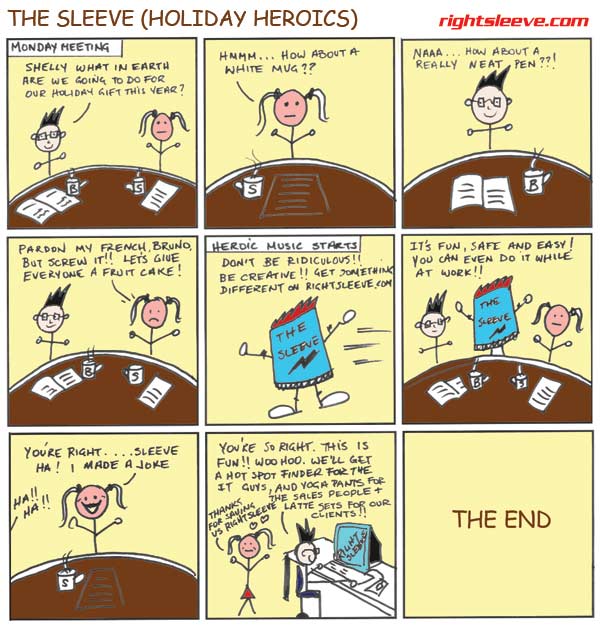
Holiday Heroics! Booo White Mugs!